_____________
Trump Administration is Set to Abandon LGBTQ+ Africans
By Daniel Volman
29 November 2024
As the results of the United States presidential election came in on 5 November 2024, showing that former President Donald Trump had won a second term, homophobic political leaders celebrated 7,000 miles away, in Uganda’s capital of Kampala. “The sanctions are gone,” Anitah Among, the country’s parliamentary speaker, told members of parliament, referring to the fact that he had been barred from entering the US by the Biden administration on 16 June 2023, after Uganda passed what was known as the “Kill The Gays” act on 28 May 2023.
The act, officially called the Anti-Homosexuality Act, was signed into law by President Yoweri Museveni on 28 May 2023. The new Ugandan law imposes life imprisonment for same-sex acts, up to 20 years in prison for “recruitment, promotion and funding” of same-sex “activities”, and anyone convicted of “attempted aggravated homosexuality” faces the death penalty.
On 8 May 2024, parliamentary speaker Anita Among proclaimed that the enactment of the law demonstrated that “the Western world will not come and rule Uganda.” And on 9 May 2024, Among tweeted: “The president … has assented to the Anti-Homosexuality Act. As the parliament of Uganda, we have answered the cries of our people. We have legislated to protect the sanctity of [the] family. We have stood strong to defend our culture and [the] aspirations of our people,” she said, thanking Museveni for his “steadfast action in the interest of Uganda”.
Speaker Among said in his tweet that Ugandan MPs had withstood pressure from “bullies and doomsday conspiracy theorists” and called for the country’s courts to begin enforcing the new law. The passage of the bill and that fact that Among and other African homophobes celebrated Trump’s re-election tells us what the next four years are going to be like for Africa’s LGBTQ+ people.
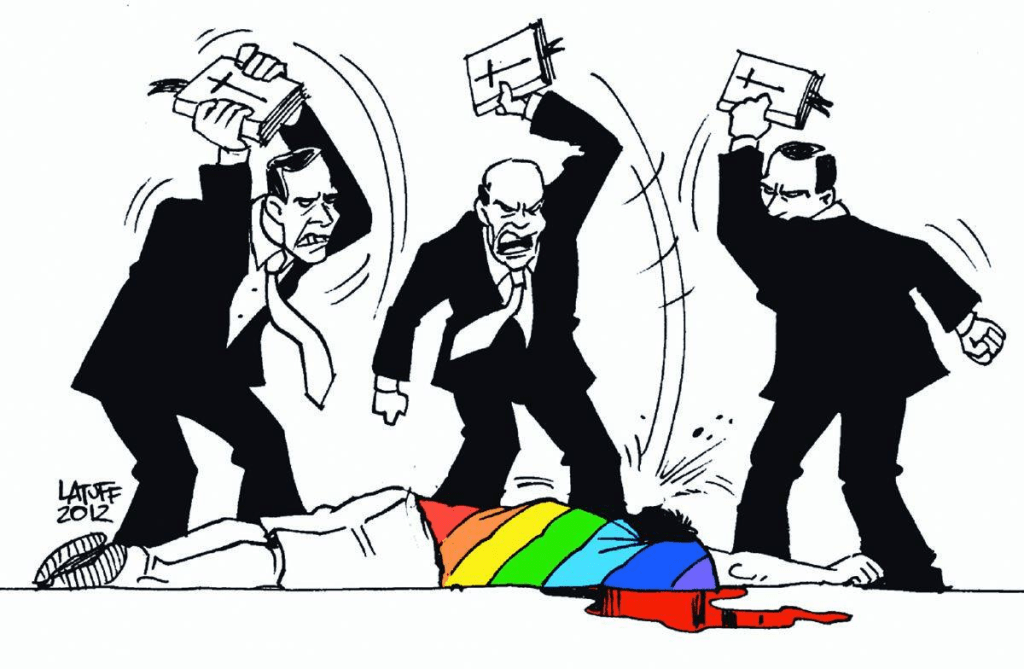
African political leaders and religious zealots (both Christian and Muslim) have used homophobia as a tool for political and religious power for many years. They say that same-sex relations and gay rights are imports from the west. They have used homophobia to portray themselves as nationalists and defenders of African and religious values. They have used homophobia to frighten and divide people to mobilize popular support and votes.
But it is homophobia, as others have said before me, that is the real import from the West. And the whole panoply of weapons employed by the homophobes in Uganda and elsewhere in Africa are themselves colonial imports, ranging from sodomy laws that were a legacy of colonial rule to the parliaments that pass these laws.
And homophobia is growing stronger in Africa. In mid-March of 2023, Ugandan President Yoweri Museveni was quoted by the Monitor newspaper website as saying that the “Western countries should stop wasting the time of humanity by imposing their social practices on us.” And Kenyan President William Ruto declared the same month that “our culture and religion does not allow same-sex marriages.”
On April 2, 2023, Museveni called upon African leaders to reject “the promotion of homosexuality” and said homosexuality was “a big threat and danger to the procreation of human race.” According to Museveni, “Africa should provide the lead to save the world from this degeneration and decadence, which is really very dangerous for humanity. If people of opposite sex stop appreciating one another then how will the human race be propagated.”
On December 29, 2023, Burundian President Evariste Ndayishimiye, speaking at an event in the country’s eastern Cankuzo Province, where he answered questions from journalists and members of the public, defiantly proclaimed that powerful nations “should keep” their aid if it comes with an obligation to give rights to LGBTQ+ persons. “I think,” Ndayishimiye declared, “that if we find these people in Burundi they should be taken to stadiums and stoned, and doing so would not be a crime.”
In Ghana, legislators have been debating the Proper Human Sexual Rights and Ghanaian Family Values Bill since it was introduced in August 2021. Same-sex relations are already punished by up to three years in jail under current law in Ghana, but this new bill will impose punishment for even identifying as LGBTQ+. It will also criminalize being transgender and includes jail sentences of up to 10 years for advocating for LGBTQ+ rights. It also imposes a legal obligation on all persons and entities to report any people perceived to be LGBTQ+ or any homosexual activity to the police or community leaders. The bill was passed by the Ghanaian parliament on 28 February 2024. Ghanaian President Nana Addo Dankwa Akufo-Addo has not yet announced whether he will sign it, saying he will await the results of two Supreme Court cases challenging its constitutionality. And on 17 July 2024, the Supreme Court issued a ruling that delayed judgement on the bill until all related legal issues have been resolved
_____________
Why African Homophobia is Still the Real Western Import
By Daniel Volman
14 February 2024
_____________
John Dramani Mahama, the former president of Ghana and a leading presidential candidate in the country’s upcoming elections, standing for the National Democratic Congress, said during a meeting with members of the clergy in eastern Ghana that gay marriage and being transgender were against his Christian beliefs. “The faith I have will not allow me to accept a man marrying a man, and a woman marrying a woman,” Mahama said while responding to a church leader’s call against LBGTQ+ people. “I don’t believe that anyone can get up and say I feel like a man although I was born a woman and so I will change and become a man,” he added. Mahama did not say whether or not he would sign the anti-LGBTQI+ bill should he win the presidential election in December 2024.
In Kenya, opposition parliamentarian Peter Kaluma introduced the Family Protection Bill in February 2023. The bill mirrors many aspects of the Ugandan law and would punish gay sex with prison for up to ten years or even death in some cases. The new bill is “cut from the same cloth” as the Ugandan legislation, said Kevin Muiruri, a Nairobi-based lawyer. The bill is being vetted by a parliamentary committee, which is expected to refer it to the full chamber for a vote. And Kenyan President William Ruto, an evangelical Christian, has already endorsed the legal repression of LGBTQI+ rights. “We cannot travel down the road of women marrying their fellow women and men marrying their fellow men,” he declared in March 2023.
More recently, the National Transitional Council of Mali, which has effectively served as the country’s legislature since the military seized power in 2020, voted on 31 October 2024 to approve a penal code that criminalizes same-sex relations by 132 votes to one. The media was not able to obtain a copy of the new penal code and the penalties imposed for same-sex acts are unknown. But, according to the Malian Minister of Justice and Human Rights, Mamadou Kasogue, “anyone who indulges in this practice, or promotes or condones it, will be prosecuted.” The bill still requires the signature of the country’s military junta, which is led by General of the Army Assimi Goita.
President-elect Trump’s foreign policy advisors have already drawn up an explicitly anti-LGBTQ+ rights foreign policy agenda for his second term in office. The Project 2025 report (prepared under the leadership of the Heritage Foundation, so the new administration can start implementing this agenda as soon as it comes into office in January 2025) states that the United States should “stop promoting policies birthed in the American culture wars” and stop pressing African governments to respect the rule of law, human rights/LGBT+ rights, political and civil rights, democracy, and women’s rights, especially abortion rights.
“African nations are particularly (and reasonably) non-receptive to the US social policies such as abortion and pro-LGBT initiatives being imposed on them,” by the United States, the report declares. Therefore, “the United States should focus on core security, economic, and human rights engagement with African partners and reject the promotion of divisive policies that hurt the deepening of shared goals between the US and its African partners.”
The principal responsibility for implementing this policy reversal on LGBTQ+ rights in Africa will fall on Trump’s appointee as Secretary of State, Marco Rubio, and whoever Trump chooses as his Assistant Secretary of State for African Affairs. It will be up to them to direct the activities and programs that Trump wants in order to endorse, encourage, promote, and fund homophobic groups and organizations in Africa, and there is no doubt that they will implement this agenda energetically and zealously.
African homophobes say they are standing up to the West and saving the continent and the world from homosexuality, but they are just serving their own selfish interests and the interests of right-wing Christian nationalists in the West. Gay communities in Africa and the West share a common interest in fighting back, and civil society groups and all genuine supporters of human rights are increasingly active. As Eric Gilari, an LGBTQ+ activist in Kenya said, “one day we shall defeat these assaults on our human rights and triumph in equality and inclusion for LGBTQ persons within African countries. This ideal must be our guiding light in this moment of darkness and tears.”
_____________
African political leaders and religious zealots (both Christian and Muslim) have used homophobia as a tool for political and religious power for many years. They say that same-sex relations and gay rights are imports from the west. They have used homophobia to portray themselves as nationalists and defenders of African and religious values. They have used homophobia to frighten and divide people to mobilize popular support and votes.
But it is homophobia, as others have said before me, that is the real import from the west (Evaristo, 2014). And the whole panoply of weapons employed by the homophobes in Uganda and elsewhere in Africa are themselves colonial imports, ranging from sodomy laws that were a legacy of colonial rule to the parliaments that pass these laws.
And yet homophobia is growing stronger in Africa. In mid-March of 2023, Ugandan President Yoweri Museveni was quoted by the Monitor newspaper website (Monitor reporter, 2023, McCool, 2023, and Africanew, 2023) as saying “The Western countries should stop wasting the time of humanity by imposing their social practices on us.” And Kenyan President William Ruto declared (Musambi, 2023 and Cyuzuzo, 2023) at the same time that “our culture and religion does not allow same-sex marriages.”
The use of homophobia as a political and religious tool in the United States goes back at least as far as the “Lavender Scare” in the 1950s, which drove hundreds of people out of government service, and Anita Bryant’s campaign against gay rights in the late-1970s. Right-wing evangelicals and their allies in the Republican Party have campaigned for more anti-gay and anti-free speech legislation in recent years. And they have sought to export their politics abroad, primarily through their promotion and funding of political activities by evangelical Christian groups.
Public attitudes and the law have changed in the US, however, and it is the current policy of the Biden administration to promote respect for LGBTQI+ persons and for human rights. On 3 March 2023, while the Ugandan parliament was debating a new Anti-Homosexuality Act, US Ambassador to Kenya Meg Whitman said (Lavers, 2023) that “Every country has to make their own decisions about LGBTQ rights,” while speaking to reporters in Kenya’s Kajiado County. “In the United States we probably have a different position, which is that we view LGBTQ rights as human rights, but we respect every country’s point of view on what position they want to take on this and we will respect that, but of course our democratic values and the way that we feel is different and that’s okay.”
A State Department spokesperson on Monday, 14 March 2023, declared, in a statement to the Washington Blade (Lavers, 2023), that “a person’s ability to exercise their rights should never be limited based on sexual orientation, gender identity or expression, or sex characteristics,” and, said the spokesperson, “governments should protect and promote respect for human rights for each and every human being, without discrimination, and they should abide by their human rights obligations and commitments.”
On that same day, 14 March 2023, Ambassador Whitman tweeted (Lavers, 2023) that “over the past week my team and I met with the LGBTQI+ community and stakeholders to support human rights of LGBTQI+ persons. The US proudly advances efforts to protect LGBTQI+ persons from discrimination and violence and will continue to stand up for human rights and equality.”
And, on 22 March 2023, White House press secretary Karine Jean-Pierre said that the White House was watching the situation in Uganda “closely” and determining what the US’s next steps should be (Bowden, 2023). “We’re certainly watching this really closely and we would have to take a look at whether or not there might be repercussions that we would have to take, perhaps in an economic way, should this law actually get passed and enacted.”
She also said (Bowden, 2023) “If the AHA is signed into law and enacted, it would impinge upon universal human rights, jeopardize progress in the fight against HIV/AIDS, deter tourism and [investment] in Uganda, and damage Uganda’s international reputation.”
And yet, the Anti-Homosexuality Bill was passed by the Ugandan parliament on 21 March 2023.
On 2 April 2023, Museveni called (McCool, 2023) upon African leaders to reject “the promotion of homosexuality” and said homosexuality was “a big threat and danger to the procreation of human race.” He said “Africa should provide the lead to save the world from this degeneration and decadence, which is really very dangerous for humanity. If people of opposite sex stop appreciating one another then how will the human race be propagated.”
He was speaking following a two-day inter-parliamentary conference held at State House in Entebbe, which was hosted by the Ugandan parliament, the African Bar Association, and the Nigerian-based Foundation for African Cultural Heritage. Delegates could also attend the conference online, hosted by the US evangelical Christian organization Family Watch International, defined as hate group by SPLC. The President of Family Watch, Sharon Slater, who also chairs the UN Family Rights Caucus Lobby group, spoke at the event.
On 20 April 2023, Museveni congratulated lawmakers for having “rejected the pressure from the imperialists,” in a statement (Reuters, 2023a) issued by his office. An amended version of the Anti-Homosexuality Act, providing for the use of conversion therapy to “rehabilitate” LGBTQI+ people, was passed on 2 May 2023 and sent to Museveni for his signature. Celebrating the act, parliamentary speaker Anita Among said (Althumani, 2023 and Reuters, 2023b) “The Western world will not come and rule Uganda.”
In a statement issued on 29 March 2023 (Biden, 2023a), President Biden called the newly-passed law “shameful” and suggested it could impact US-Uganda relations. “I have directed my National Security Council to evaluate the implications of this law on all aspects of US engagement with Uganda, including our ability to safely deliver services under the US President’s Emergency Plan for AIDS Relief (PEPFAR) and other forms of assistance and investments.”
On 16 June 2023, the State Department announced (Miller, 2023 and Reuters, 2023c) that the US has imposed visa restrictions on Ugandan officials after the passage of the AHA bill. The statement did not mention any names or even the number of officials, but said that the US would hold accountable those who are responsible for abusing human rights in Uganda, “including those of LGBTQI+ persons.” And on 30 October 2023, President Biden announced (Biden, 2023b) that Uganda would be suspended from participation in the African Growth and Opportunity Act, which grants African countries duty-free access to the American market for more than 1,800 products (including coffee and textiles from Uganda), due to “gross violations of internationally recognized human rights” by the government.
In fact, right-wing Christian groups in the United States have long influenced or supported anti-LGBTQ policies and attitudes in Uganda, particularly via evangelical groups like the Fellowship Foundation, which participated in drafting the 2009 “kill the gays” bill, according to a 2020 report from Open Democracy. In 2012, Sexual Minorities Uganda (SMUG) sued American evangelist Scott Lively in a US court for his role in promoting the anti-LGBTQ propaganda that supported the “kill the gays” bill and led to the persecution of LGBTQ people in Uganda. Though the court eventually dismissed the case, ruling that it could not be tried in the US because the alleged crimes took place elsewhere, the presiding judge, Michael Ponsor, affirmed (Khatondi, 2023b and Khantondi, 2023c) that Lively contributed to “a vicious and frightening campaign of repression against LGBTQI people in Uganda.”
And one major US lobbying group has faced persistent accusations of spreading anti-LGBTQ propaganda in several African countries. CNN (McKenzie and Dean, 2023) investigated whether the Arizona-based organization Family Watch International, and its founder Sharon Slater, have helped promote homophobic legislation in Uganda, Kenya and Ghana. The group has repeatedly denied these allegations.
Family Watch International says that its mission is to “protect and promote the family as the fundamental unit of society.” It is opposed to teaching young people about LGBTQ issues, sexual health, and other areas it regards as a threat to the “natural family,” and it engages in lobbying at the United Nations, across the US and in other countries. Ms. Slater has addressed or convened multiple “family values” conferences across the African continent – both in person and remotely.
Policy advocacy by American conservative groups in Africa is not a new phenomenon. CNN has previously reported that the World Congress of Families, a right-wing US group, may have played a role in a crackdown on Ghana’s LGBTQ community, including by promoting some of the harshest bills on the continent. At the time, their leader said they had no influence on the Ghanaian bill.
In 2013, Nigeria passed a bill criminalizing same-sex relationships, which contained penalties of up to 14 years in prison. A year later, Uganda’s president signed into law an earlier version of the Anti-Homosexuality Act, which was subsequently struck down by a Ugandan court on procedural grounds.
Ghana’s parliament is now considering one of the harshest pieces of legislation, known as the Human Sexual Rights and Ghanaian Family Values bill, after its Supreme Court dismissed a legal challenge in July.
“The laws are very organized in their planning and the political mobilization of the population to support the cause. The passing of the law is just the tail end of that very meticulous process,” says Nicholas Opiyo, a leading Ugandan human rights advocate.
Perhaps the most symbolic illustration of Family Watch International’s influence came from a conference in Entebbe, Uganda, in April 2023. In one photo from the conference, Family Watch International staff and co-founder Slater stands in a small group photo with the Ugandan president.
The conference took place just weeks before Museveni signed the Anti-Homosexuality Act. Museveni and the First Lady publicly praised the work of Slater and her organization. Family Watch International says those meetings were impromptu and that it was not in charge of the conference in Entebbe. But a source directly involved in the event said that Slater and Family Watch International were, in fact, vital in the planning of the Entebbe conference, even suggesting a name change to avoid “significant backlash.”
And while Family Watch International says it was not involved in any way in the law, the same source said the group has assisted members of parliament in pushing the legislation and helped shape its wording. “Family Watch International staff made repeated changes to the draft,” the source said, even suggesting clauses that should be added to the text. CNN tracked Slater to a conference at the UN headquarters in New York in November. The Family Watch International co-founder said that the allegations are “absurd.”
“I have documents I can show you later that I have not been involved in any of those laws, period, it’s just absurd,” she said. Asked to show the documents, a Family Watch International representative later shared a deeply homophobic text with CNN from President Yoweri Museveni’s office. It says Museveni endorses Slater’s work and that she played no part in “originating, canvassing, or supporting” the law. Instead, it says she suggested a “safe haven” for “homosexuals.” The final Ugandan law signed by Museveni allows for the “rehabilitation of offenders,” including the use of conversion therapy.
Family Watch International has repeatedly insisted that it is against the death penalty and imprisonment of members of the LGBTQ community and does not support the law, but a youth leader with close links to the organization in Kenya told a different story.
Tobias Nauruki, a representative of the Empowered Youth Coalition, had just returned from the same meetings at the UN, where he posted photographs of the UN buildings and group pictures with leading anti-LGBTQ members of parliament. Family Watch International said that Nauruki is “not authorized to speak” for them.
“I’m happy for the laws being pushed. One, they are going to protect me as a person, Tobias, and the generations I’m looking forward to have in the near future,” he said. “The maintenance protection and promoting the family values is very important to maintain the traditions that have been there.”
Nauruki said that LGBTQ people should be imprisoned if they break the laws but be given the opportunity to convert. He added that the instances of harassment and abuse of LGBTQ people cited by human rights groups are “minor.”
According (Khatondi, 2023a) to Fox Odoi-Oywelowo, one of only two Ugandan MPs who voted against the AHA, “leading up to the first Anti-Homosexuality Bill in 2014, we knew that radical Pentecostal communities from the US were sponsoring the introduction of anti-LGBTIQ laws throughout Africa. There are still a few US pastors – I call them hate-mongers because that’s all they excel in, vending hatred in Uganda.”
“Their initial point of entry was the [Ugandan] National Prayer Breakfast, a collection of religious and radical people here who introduced that ideology of hate. They sit over breakfast and pray and make radical hate speeches. They also introduced some money. They hold fellowships in expensive hotels, attended by MPs. They also sponsor trips for MPs – to Jerusalem, for example – and basically indoctrinate them.”
“That was the cycle we had from 2011 to around 2016. They were successful in introducing the anti-homosexuality law to Parliament and having it passed; we were successful in having it struck down. We also had lengthy discussions with the LGBTIQ community here, and advised them to file lawsuits against those fellows back in the US. It scared away a number of them.”
“Last year I was told that those Pentecostal communities spent well over $26m in East Africa to – again – promote this anti-homosexuality law. We tried to fight it politically. At one point, we were convinced we had won the battle until it hit us this month. They have never gone to sleep. Also, we lowered our guards and were not very aggressively following the money.”
Despite the negative publicity the law has provoked, Representative Tim Walberg (R-Michigan) urged (Bollinger, 2024 and Migdon, 2023) attendees of the Uganda National Prayer Breakfast, including Museveni, Bahati, and others, to resist pressure to repeal it. “Though the rest of the world is pushing back on you . . . though there are other major countries that are trying to get into you and ultimately change you, stand firm,” Walberg said, as first reported by the Take Care, Tim blog in October.
Walberg quoted Biblical parables and used them to encourage Ugandans to shrug off international condemnation of the law. “Worthless is the thought of the world…. [W]orthless, for instance, is the thought of the World Bank, or the World Health Organization, or the United Nations, or, sadly, some in our administration in America who say, ‘You are wrong for standing for values that God created,’ for saying there are male and female and God created them.’”
“Whose side do we want to be on? God’s side,” Walberg added. “Not the World Bank, not the United States of America, necessarily, not the U.N. God’s side.” He also urged Ugandan leaders to stand by Museveni. “He knows that he has a Parliament, and…even congressmen like me who will say, ‘We stand with you.’”
Museveni cited Walberg’s attendance and his remarks as evidence that many conservatives in the West support laws against homosexuality in the name of religion and support Uganda and other nations’ efforts to legislate against it. “There are others, also, who come to tell you about homosexuals, about abortion. You now know that there are other Americans, other Western people, who think like us,” he said.
Bahati praised Walberg, recounting a conversation with the congressman about whether he was comfortable braving potential backlash or criticism for traveling to Uganda and expressing support for the law. He said Walberg told him, “Don’t worry, we are on the right side of God.”
According to the “Take Care, Tim” blog (TYT), a congressional travel filing from Walberg revealed that it was paid for by the Fellowship Foundation, or the “International Foundation,” known more colloquially as “The Family,” which organizes the U.S. National Prayer Breakfast, and has long advocated for anti-LGBTQ and anti-abortion policies, both domestically and abroad. Walberg’s speech marks the first time any American lawmaker has publicly embraced Uganda’s attempts to further criminalize homosexuality.
Other right-wing US groups also supported the AHA, including Family Watch International, an SPLC-designated hate group based in Arizona. Family Watch International’s President Sharon Slater has a close relationship with Museveni’s wife, Janet Museveni, as well as with Ugandan MP Martin Ssempa, one of the most enthusiastic supporters of the kill the gays law.
“I recently had the honor of meeting with Ms. Sharon Slater, President of Family Watch International, and her team,” Janet Museveni tweeted last year. “They attended the first African Regional Inter-Parliamentary Conference in Uganda, focusing on global challenges that threaten African families and values.”
Nicolas Opiyo, a Ugandan human rights lawyer and campaigner, told (McCool, 2023) the Guardian that “The wave of homophobia and transphobia in Uganda, and the region, has nothing to do with Ugandan or African values. It is a disguised campaign by American evangelicals through their local actors. Their campaigns have now been organized under what appears to be local professional entities such as Christian lawyers’ groups, parliamentary forums and so forth. Their claim about African family values is only a ‘dog whistle’, a hate campaign and an imposition of a narrow Christian worldview upon us all.”
Robert Akoto Amoafo, a Ghanaian human rights advocate, told (Dini-Osman, 2023) the World on 11 April 2023, “In Uganda, in Ghana, in Kenya, in Mali and in Niger, it’s only politicians that are making these statements. And, of course, politicians who see this as an opportunity to make more numbers for their votes,” referring to Ghana’s upcoming 2024 elections.
Many of the American evangelists who came to Uganda in the 1990s still live there, Stella Nyanzi told (Tschierse and Eisele, 2023) Deutsch Welle. “We have a number of churches where the senior pastor is an American. Pastor Martin Ssempa, one of the most vocal homophobes and one of the biggest mobilizers of the anti-gay movement is married to an American.”
It would be simplistic to explain everything as the result of external actors, says Barbara Bompani (Bompani, 2023) in a 26 October 2023 article in the Review of African Political Economy entitled “’God-fearing nations’—understanding the rise of homophobia and homophobic legislation in East Africa and beyond.” And she is quite correct to insist on the primacy of internal factors and actors. But American right-wing evangelical Christians clearly play a key role in mobilizing, organizing, supporting, and funding homophobic groups and individuals in Africa. This has already caused enormous damage in a number of African countries. And all the signs point in the direction of greater legal persecution and violence against LGBTQI+ people in Africa.
On 29 December 2023, Burundian President Evariste Ndayishimiye said (Cyuzuzo, 2023) at an event in the country’s eastern Cankuzo Province, where he answered questions from journalists and members of the public, that powerful nations “should keep” their aid if it comes with an obligation to give rights to LGBTQ persons. “For me, I think that if we find these people in Burundi they should be taken to stadiums and stoned, and doing so would not be a crime.” On 6 January 2024, State Department spokesperson Matthew Miller issued a statement (White House, 2024 and Reuters, 2024a) saying that “the United States is deeply troubled by President Ndayishimiye’s remarks targeting certain vulnerable and marginalized Burundians.”
In Ghana, (Ansari, 2024 and Reuters, 2024b) parliamentarians have been debating the Human Sexual Rights and Ghanaian Family Values bill since August 2021. Same-sex relations are already punishment by up to three years in jail under current law, but this new bill will introduce punishment for even identifying as LGBTQ+. It will also criminalize being transgender and includes jail sentences of up to 10 years for advocating for LGBTQ+ rights. It is now moving through the Ghanaian parliament.
John Dramani Mahama, the former president of Ghana and leading presidential candidate of the National Democratic Congress, said (Reuters, 2024b) during a meeting with members of the clergy in eastern Ghana that gay marriage and being transgender were against his Christian beliefs. “The faith I have will not allow me to accept a man marrying a man, and a woman marrying a woman,” Mahama said while responding to a church leader’s call against LBGTQ+ people. “I don’t believe that anyone can get up and say I feel like a man although I was born a woman and so I will change and become a man,” he added. Mahama did not say whether or not he would sign the anti-LGBTQI+ bill should he win the presidential election in December 2024.
In Kenya,(Ansari, 2024 and Mersie and Hlatshwayo, 2023) opposition parliamentarian Peter Kaluma introduced the Family Protection Bill. The draft of the bill, which was seen by Reuters, mirrors many aspects of the Ugandan law and would punish gay sex with prison for up to ten years or even death in some cases. The new bill is “cut from the same cloth” as the Ugandan legislation, said (Ansari, 2024) Kevin Muiruri, a Nairobi-based lawyer. The bill is now being vetted by a parliamentary committee, which can then refer it to the full chamber for a vote. And Kenyan President William Ruto, an evangelical Christian, has already endorsed the legal repression of LGBTQI+ rights. “We cannot travel down the road of women marrying their fellow women and men marrying their fellow men,” he declared (Mersie and Hlastshwayo, 2023) in March 2023.
African homophobes say they are standing up to the west and saving the continent, but they are just serving their own interests and the interests of right-wing Christian nationalists in the west. Gay communities in Africa and the west share a common interest in fighting back and civil society groups are increasingly active. The suspension of Uganda from AGOA is a good first step, but we need to press for further action. As Eric Gilari, an LGBTQI+ activist in Kenya said (Sands and Ombuor, 2023) “one day we shall defeat these assaults on our human rights and triumph in equality and inclusion for LGBTQ persons within African countries. This ideal must be our guiding light in this moment of darkness and tears.”
NOTES:
Africanew reporter, 2023, “Uganda: Museveni calls gay people ‘deviants’ as anti-LGBT bill advances,” Africanews, 16 March 2023.
Ansari, S. 2024, “How new anti-LGBTQ+ bills in Africa expand crackdown on rights,” Openly News, 29 January 2024.
Athumani, H. 2023, “Ugandan Parliament Passes Harsh Anti-LGBTQ Bill,” Voice of America, 2 May 2023.
Biden, J. 2023a, “Statement from President Joe Biden on the Enactment of Uganda’s Anti-Homosexuality Act,” 29 May 2023.
Biden, J. 2023b, “Letters to the Speaker of the House and President of the Senate on Intent to Terminate the Designation of the Central African Republic, the Gabonese Republic, Niger, and the Republic of Uganda as Beneficiary Sub-Saharan African Countries Under the African Growth and Opportunity Act,” 30 October 2023.
Bollinger, A. 2024, “GOP lawmaker told Uganda to ‘stand firm’ on its ‘Kill the Gays’ bill,” LGBTQ Nation, 11 January 2024.
Bompani, B. 2023, “’God-fearing nations’ – understanding the rise of homophobia and homophobic legislations in East Africa and beyond,” Review of African Political Economy, 26 October 2023.
Bowden, J. 2023, “White House says sanctions against Uganda possible over anti-gay law,” Independent, 22 March 2023.
Cyuzuzo, S. 2023, “Burundi’s President Ndayishimiye hits out over gay rights and aid,” BBC, 29 December 2023.
Dini-Osman, R. K. 2023, “Uganda’s LGBTQ crackdown could have a ripple effect in Ghana and other African countries,” The World, 11 April 2023.
Evaristo, B. 2014, The idea that African homosexuality was a colonial import is a myth,” Bernardine Evaristo, Guardian, 8 March 2014.
Khatondi S. W. 2023a, “Christian fundamentalism lies behind harsh new anti-LGBTIQ bill in Uganda,” Open Democracy, 23 March 2023.
Khatondi S. W. 2023b, “Queer Ugandans reveal devastating impact of anti-gay law,” Open Democracy, 4 July 2023.
Khatondi S. W. 2023c, “The West harms queer Africans by failing to hold its own people accountable,” Open Democracy, 27 July 2023.
Lavers, M. 2023, “U.S. ambassador to Kenya: Every country must make ‘own decisions’ about LGBTQ rights,” Washington Blade,14 March 2023.
McCool, A. 2023, “Ugandan president calls on Africa to ‘save the world from homosexuality,’” Guardian, 3 April 2023.
McKenzie, D. and Dean, S. 2023, “Activists link US nonprofit to anti-LGBTQ laws in Africa: The group says it’s only promoting ‘family values,’” CNN, 18 December 2023.
Mersie, A. and Hlatshwayo, M. 2023, “Insight: Kenya could follow Uganda as East African nations wage war on LGBT rights,” Reuters, 27 June 2023.
Migdon, B. 2023, “GOP House member tells Uganda to ‘stand firm’ in face of opposition to anti-gay law,” The Hill, 29 December 2023.
Miller, M, 2023, “Visa Restrictions for Undermining the Democratic Process in Uganda,” Department of State Press Statement, 16 June, 2023.
Monitor reporter 2023, “Stop imposing homosexuality on us, Museveni tells the West,” Monitor,16 March 2023.
Musambi, E. 2023, “Kenya’s president criticizes court ruling on LGBTQ group,” Associated Press, 2 March 2023.
Reuters 2023a, “Uganda’s Museveni wants ‘rehabilitation’ measures in anti-LGBTQ legislation,” Reuters, 21 April 2023.
Reuters 2023b, “Uganda parliament passes mostly unchanged version of anti-lgbtq bill,” Reuters, 2 May 2023.
Reuters 2023c, “US imposes visa restrictions on Uganda officials after anti-lgbtq law,” Reuters, 16 June 2023.
Reuters 2024a, “US expresses concern after Burundi president says gay people should be stoned,” Reuters, 5 January 2024.
Reuters 2024b, “Ghana’s opposition leader expresses anti-LGBTQ stance ahead of Dec. elections,” Reuters, 31 January 2024.
Sands, L. and Ombuor, R. 2023, “Uganda imposes death penalty for ‘aggravated homosexuality,’” Washington Post, 29 May 2023.
Tschierse, K. and Eisele, I. 2023, “Why is homophobia so strong in Uganda?” Deutsche Welle, 21 April 2023.
White House 2024, “United States is deeply troubled by President Ndayishimiye remarks targeting certain vulnerable and marginalized Burundians,” The White House, 6 January 2024.
_____________
 African Security Research Project